

Taiwan
Taiwan has seen a steady influx of new business as they have always been known for high precision-high tech manufacturing. While Taiwan has not had the reputation for lowest cost labor, it leads in high tolerance parts such as those found in automotive, aviation, and other engine parts.
Core Industries: Electrical, semiconductor, machinery, vehicles, and medical apparatus.
Three benefits of manufacturing in Taiwan
1. Government Initiatives
The Taiwanese government is cognizant of the important role that manufacturing has in the county. The ‘Taiwan 4.0’ initiative that is currently in progress seeks to increase efficiency in the manufacturing sector through the implementation of high-tech tools. This is a major benefit that can offset labor costs and mitigate the risk of worker shortages such as the ones seen during the COVID-19 pandemic.
2. Ease of doing business
The ease of doing business in Taiwan is a major selling point, especially when compared to China. Travel to Taiwan to establish manufacturing partnerships and conduct quality control is made simple given visas are not required for entry into the country.
3. Logistics
Taiwan’s prime geographical location and infrastructure factor into the country’s excellent standing in terms of logistics. Shipping times from Taiwan are famously quick. With speed to market being a critical point for many businesses, this makes Taiwan an incredibly attractive manufacturing destination.
Learn more about manufacturing alternatives in Southeast Asia with our handbook – download it today!
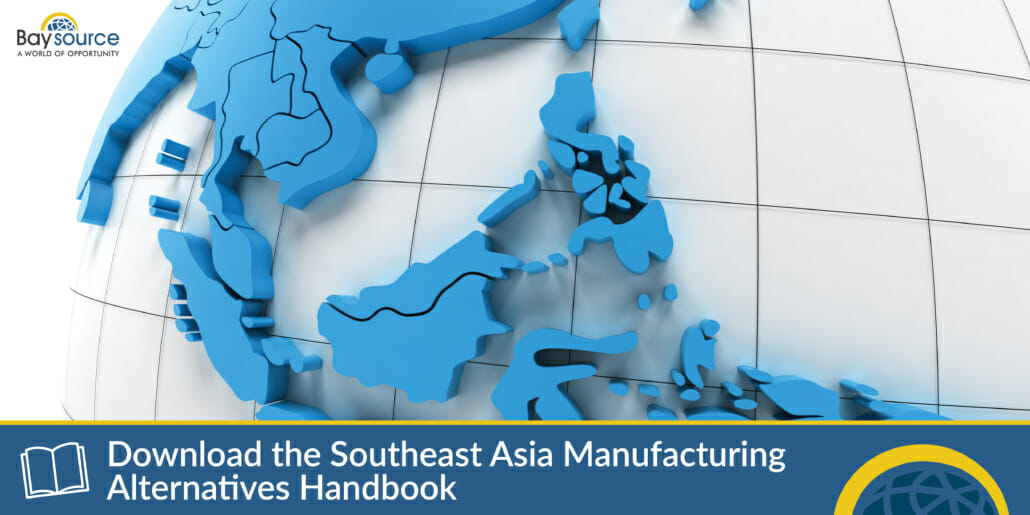
Southeast Asia Manufacturing Alternatives Handbook
 https://baysourceglobal.com/wp-content/uploads/2026/02/Baysource-Headers-6.jpg
1050
2050
dwatts
https://baysourceglobal.com/wp-content/uploads/2013/04/BSG-new-logo-large1-e1426014540772.jpg
dwatts2026-02-05 01:10:372026-07-09 13:32:31Factory Due Diligence in China: Why Operating Partners Should Treat It as a Value Creation Strategy—Not Just a Procurement Exercise
https://baysourceglobal.com/wp-content/uploads/2026/02/Baysource-Headers-6.jpg
1050
2050
dwatts
https://baysourceglobal.com/wp-content/uploads/2013/04/BSG-new-logo-large1-e1426014540772.jpg
dwatts2026-02-05 01:10:372026-07-09 13:32:31Factory Due Diligence in China: Why Operating Partners Should Treat It as a Value Creation Strategy—Not Just a Procurement Exercise https://baysourceglobal.com/wp-content/uploads/2026/02/ebitda-trap-contract-manufacturing-pe-backed-companies.jpg
1050
2050
dwatts
https://baysourceglobal.com/wp-content/uploads/2013/04/BSG-new-logo-large1-e1426014540772.jpg
dwatts2026-02-05 00:47:242026-05-27 16:10:55When Cost Savings Destroy Value: The Hidden Risk of Low-Cost Contract Manufacturing
https://baysourceglobal.com/wp-content/uploads/2026/02/ebitda-trap-contract-manufacturing-pe-backed-companies.jpg
1050
2050
dwatts
https://baysourceglobal.com/wp-content/uploads/2013/04/BSG-new-logo-large1-e1426014540772.jpg
dwatts2026-02-05 00:47:242026-05-27 16:10:55When Cost Savings Destroy Value: The Hidden Risk of Low-Cost Contract Manufacturing https://baysourceglobal.com/wp-content/uploads/2026/02/Baysource-Headers-5.jpg
1050
2050
dwatts
https://baysourceglobal.com/wp-content/uploads/2013/04/BSG-new-logo-large1-e1426014540772.jpg
dwatts2026-02-04 23:45:262026-03-25 20:20:35The First 180 Days: Stabilizing Offshore Manufacturing After an Acquisition
https://baysourceglobal.com/wp-content/uploads/2026/02/Baysource-Headers-5.jpg
1050
2050
dwatts
https://baysourceglobal.com/wp-content/uploads/2013/04/BSG-new-logo-large1-e1426014540772.jpg
dwatts2026-02-04 23:45:262026-03-25 20:20:35The First 180 Days: Stabilizing Offshore Manufacturing After an Acquisition

Follow Us