
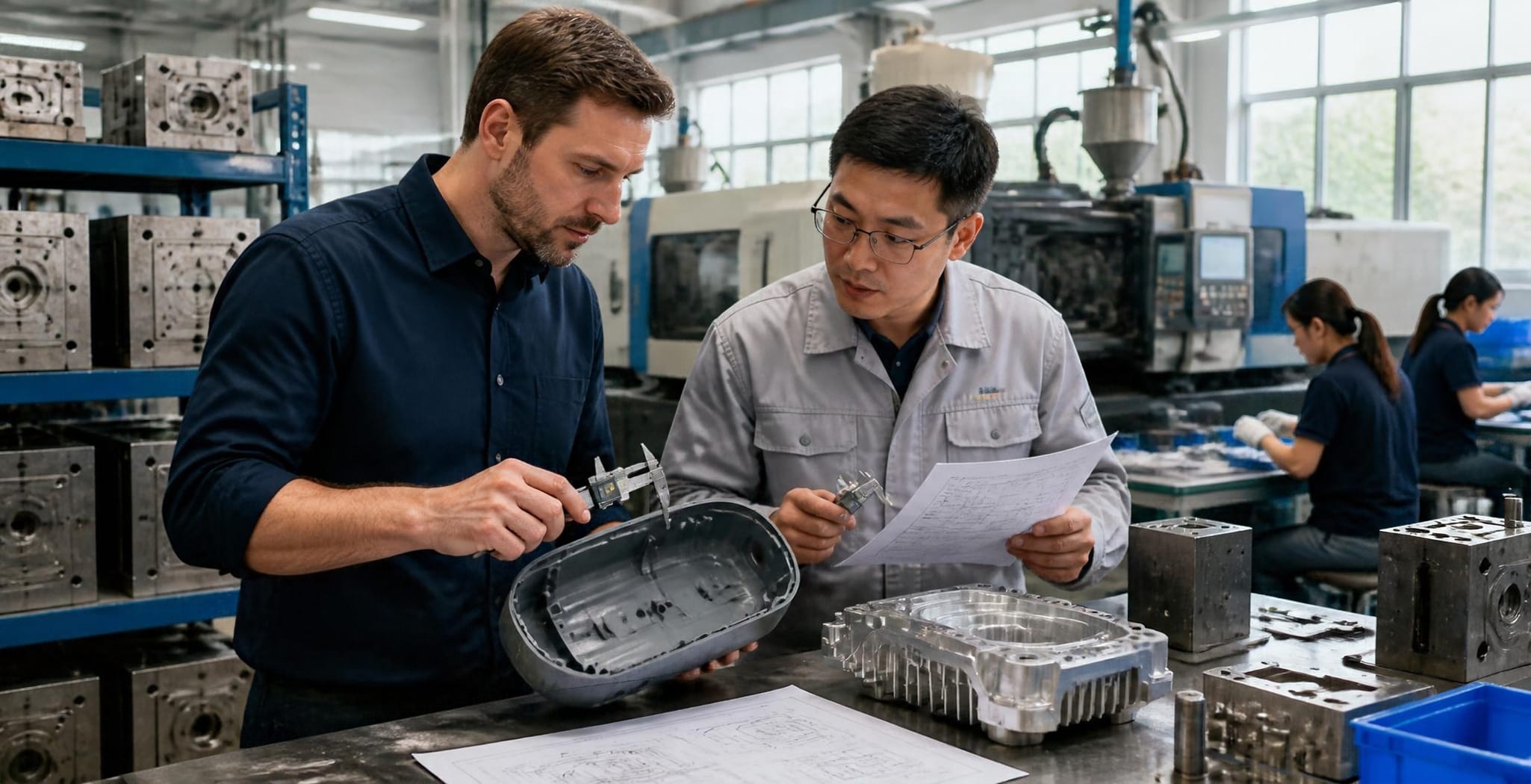
An assessment of supplier depth, tariffs, and total landed cost.
For a company developing a new product, the manufacturing decision begins well before the first production order. A design may need a machined prototype, a revised plastic housing, a different motor, and several rounds of testing before it is ready to scale. The best manufacturing location is often the one that can make those changes reliably and reach repeatable production at a competitive total cost.
For many metal, plastic, and electromechanical products, China is likely to retain that advantage over the long term. This is a commercial judgment about its manufacturing network, not a prediction that tariffs will disappear or that China is the right choice for every product.
Supplier depth matters during development
China’s advantage is often explained as lower labor cost. That explanation misses much of what makes it useful for new product development. A product combining a stamped bracket, injection-molded enclosure, motor, control board, and final assembly requires several specialized capabilities. Access to toolmakers, component vendors, fabricators, and assemblers gives a development team more options when a design changes or a supplier cannot meet a specification.
China’s 2023 economic census counted 4.048 million manufacturing enterprises, and metal products and general-purpose machinery were its two largest industrial categories by enterprise count. The U.S. also has excellent manufacturing specialists. The recurring challenge for new product developers is that even after a thorough search for qualified suppliers, U.S. contract manufacturers often won’t accept a particular project’s volume, tooling budget, or schedule.
The value of an experienced consultant on the ground
China’s supplier depth is a major advantage, but only when a company can identify the right factories and manage the details through clear communication. An experienced contract manufacturing consultant in China can help translate product requirements into clear specifications, qualify suppliers across metalworking, plastics, electronics, and assembly, and coordinate prototype and tooling changes as the design evolves.
Local oversight can shorten the time between identifying a problem and correcting it. A manufacturing consultant in China can review samples with a factory, verify that a proposed material or component substitution meets the specification, and check tooling and production readiness before a shipment is committed. Factory visits and in-process inspections can reveal issues that might otherwise surface only after finished units arrive in the United States.
A typical broker does not guarantee faster development or eliminate risk. The real value lies in technical competence, independence from the factories being evaluated, and clear accountability to the buyer. A trusted resource can reduce delays, quality failures, and costly misunderstandings, particularly when a new product requires multiple suppliers.
Mitigating tariffs
As of October 2026, an importer must evaluate U.S. duties product by product. The ordinary tariff rate depends on the product’s Harmonized Tariff Schedule classification. Additional Section 301 duties continue to apply to covered Chinese goods, subject to applicable exclusions. Certain steel and aluminum articles and derivatives can also face Section 232 duties. Classification and the scope of each measure matter for parts and finished products alike.
The tariff picture changed significantly this year. In February 2026, the U.S. Supreme Court struck down the tariffs imposed under the International Emergency Economic Powers Act (IEEPA). The administration then imposed a temporary 10% import surcharge under Section 122, which expired on July 24, 2026. Neither change should be built into a cost estimate without checking what is legally in force for the product and entry date.
Tariffs are not a bookkeeping detail. A U.S. International Trade Commission study found that U.S. importers bore nearly the full cost of the Section 301 tariffs it examined. A sourcing model should therefore include the applicable duty rather than assume a Chinese supplier will absorb it.
The India and Southeast Asia experiment
The April 2025 “Liberation Day” tariffs accelerated a push to relocate manufacturing to India, Vietnam, Cambodia, and Thailand. For many companies, that move has proven untenable.
“A year after shifting production and sourcing out of China to avoid higher U.S. tariffs, some companies are learning that replicating the country’s factory ecosystem is not so easy and are bringing manufacturing back.” (Reuters, September 2026)
Consider the following examples:
| Company | What happened | Why |
|---|---|---|
| Outdoor furniture exporter | Closed a Vietnam workshop opened in 2024 and returned production to China in 2026. | Missing equipment, imported Chinese screws and molds, and little overall cost advantage. |
| Major U.S. retailer | Returned production to China. | Production constraints and supply chain disruptions. |
| U.S. agricultural machinery customer | Restored orders to China after moving some sourcing to India. | Communication difficulties, missed specifications, and inconsistent quality. |
Reducing dependency on China takes far longer than a spreadsheet suggests. Its manufacturing ecosystem was built over 30 years. Baysource has long tracked China manufacturing alternatives, and the lesson holds: a second-country strategy has to be judged on capability, not just the tariff rate.
What Xi’s visit changed, and what it did not
President Xi Jinping’s September 2026 state visit to Washington produced a modest opening for trade talks. According to the White House, the two governments reached consensus on recommendations for more favorable tariff treatment for $30 billion of nonsensitive goods in each direction. They also put bilateral trade and investment boards into operation. China’s ambassador subsequently described an agreement to extend the tariff suspension.
For U.S. brands, the practical reading is cautiously optimistic. The visit established channels for negotiation and signaled a willingness to avoid immediate escalation. It did not remove Section 301 duties or resolve disputes over industrial capacity, critical minerals, and technology. USTR’s 2026 investigation into structural excess capacity shows that further trade action remains possible. Proposed tariff relief belongs in a sourcing budget only after the covered products, effective dates, and implementing rules are confirmed.
Compare landed cost, not factory price
A sound comparison places Chinese and U.S. quotations on the same basis: compliant finished units delivered where the buyer needs them. For an import, that includes the factory price, applicable duties, international freight, insurance, customs and port charges, domestic delivery, and the cost of carrying additional inventory. Both options should account for tooling, engineering changes, inspection, defects, and warranty exposure. The U.S. International Trade Administration advises companies to calculate the full landed cost and verify classification and tariffs with a customs broker or freight forwarder.
Consider a purely illustrative product quoted at $70 per unit from a Chinese factory and $110 from a U.S. manufacturer. If the applicable additional duty were 25% of a $70 customs value, it would add $17.50. Another $12 for freight, clearance, and inland delivery would bring the illustrative imported cost to $99.50, still below the $110 domestic quote. If duties, shipping, inventory costs, or defect rates rise enough, that result can reverse. The example shows how to test a decision; neither the quotes nor the duty rate are presented as typical.
China will remain competitive despite tariffs when its startup costs, production, and component sourcing advantages cover the added import costs. This is especially relevant to a product that requires several fabrication processes and repeated changes before launch. U.S. production may be the stronger choice when freight is high relative to product value, delivery time is critical, or close work with a domestic factory lowers development risk.
A durable advantage must be demonstrated on each project
The strongest long-term case for China is its combination of supplier choice, component availability, tooling capacity, and experience moving products from prototype to volume production. A qualified consultant on the ground can help a U.S. company put those capabilities to work while managing the practical risks of distance, supplier selection, and quality control.
Tariffs raise the hurdle, and U.S. importers pay a meaningful share of that cost. Yet a tariff on a lower manufacturing price does not automatically make the delivered product more expensive than a domestic alternative. For operations leaders, the decision should come from competing qualified bids and a realistic landed-cost model, with tariff and lead-time scenarios tested before tooling is committed. On that basis, China is likely to remain one of the strongest options for developing and contract manufacturing complex metal, plastic, and electromechanical products for years to come.
Weighing China against a domestic or Southeast Asia option for your next product? Talk with Baysource about a landed-cost comparison and supplier qualification on the ground in China.
https://baysourceglobal.com/wp-content/uploads/2026/10/china-contract-manufacturing-new-product-development.jpg
1050
2050
Shannon Kelly
https://baysourceglobal.com/wp-content/uploads/2013/04/BSG-new-logo-large1-e1426014540772.jpg
Shannon Kelly2026-10-15 16:35:572026-10-15 16:37:37Why China Is Likely to Remain a Leading Choice for New Product Contract Manufacturing https://baysourceglobal.com/wp-content/uploads/2026/02/Baysource-Headers-6.jpg
1050
2050
dwatts
https://baysourceglobal.com/wp-content/uploads/2013/04/BSG-new-logo-large1-e1426014540772.jpg
dwatts2026-02-05 01:10:372026-07-09 13:32:31Factory Due Diligence in China: Why Operating Partners Should Treat It as a Value Creation Strategy—Not Just a Procurement Exercise
 https://baysourceglobal.com/wp-content/uploads/2026/02/ebitda-trap-contract-manufacturing-pe-backed-companies.jpg
1050
2050
dwatts
https://baysourceglobal.com/wp-content/uploads/2013/04/BSG-new-logo-large1-e1426014540772.jpg
dwatts2026-02-05 00:47:242026-05-27 16:10:55When Cost Savings Destroy Value: The Hidden Risk of Low-Cost Contract Manufacturing
Contact Us

Follow Us